The Castor Cracking Group history.
I
I think Castor Cracking Group was formed in 1996, I think it was after we (my brother and I) had sold our 48K bought a 128K. The group consisted of me (Cobra), my brother (Marulk) and a friend from school (Heradotos). He had a C64 so already from the start we were active on two platforms.
Already on the 48K I had started to build up a network of contacts around the world. Some of them also used aliases and some were even organised in groups such as The Israeli Team, but as far as I knew nobody made any demos. We had probably seen some intros on the C64 and we decided to make something like that.
Our first demo was called Castor Intro and was written in BASIC compiled to assembler using a BASIC compiler we found while cracking the game "Sorcerer". Even if it was written in BASIC and with the limitations of the compiler it wasn't that bad. It was in two parts. The first part had an attribute scroll in the upper third and a single pixel bouncing with a dzzt-dzzt sound in the lower two thirds. The second part had an eight pixel high scrolltext. The text was scrolled by rewriting the entire text so it jumped eight pixels each update, on the other hand it was very slow.
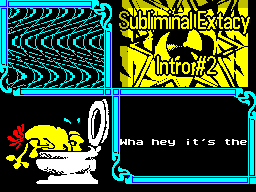
The second was more advanced and because we had a Multiface 128 it contained ripped graphics from Trap Door and music from Zombie. It's interesting to note that we made use of the filenames to provide some animation during loading. By using screen position and attribute codes in the filename things happen on the screen when the filename is printed. The demo itself was written in BASIC with an assembler scroll routine, a concept that we continued to use for several demos. Castor Intro 3 used the same concept as Intro 2, but this time it also featured a small assembler routine to draw a screen while playing a sound.
II
The graphics was made using our own Screen Editor, a very primitive program where you could draw a picture pixel by pixel. Castor Intro 4 was the first that used more advanced graphics drawn by ourselves. We still didn't have any graphics program, but we had GAC and used it to draw the graphics.
Castor Intro 5 was a bit different from the rest. It was written entirely in assembler, but on the other hand all it did was to play a sampled sound. At the time we didn't know anything about the memory interrupt so the sound lost some of the quality. A better version of the sampling and replaying routines made a comeback in 128 Demo.
Castor Intro 6 was back on the traditional concept and made use of graphics from Gauntlet and Eureka, and music from Gyroscope.
The music was also released in a program of it's own called Don't Stop the Music.
Castor Intro 7 was never made. We had the idea to make a 007 demo, but we didn't have the James Bond game to rip graphics from and when we finally got our hands on it the idea had lost it's appeal.
Castor Intro 8 was the first real demo to be written entirely in assembler. There isn't much to say about it. It was a picture from Dan Dare that was used in a couple of different ways, some text and some sound effects.
With Castor Intro 9 our demos had become significantly more advanced. This was the first of our demos to use AY music (from Saboteur II) and it even had an equalizer. The demo also worked on a 48K, but of course without the music.
In Castor Intro 10 we announced that we were leaving the Speccy for the Amiga. On the Amiga we had the addition of musician Tumus and went under the name PowerDrive. But that's another story.
This isn't the end of the story. In one PowerDrive demo we used the system font and colours from the Speccy, but the Speccy activity was nil for a very long time.
III
In 1998 CCG made a small, but still important, return to the Speccy scene when I sent in a picture to the FunTop demo party.
It didn't take part in the graphics compo since it was based on a scanned picture. Our coder DoWN had also been working on a demo, but it wasn't (and still isn't) finished.
The next year I sent a picture to the PHAT9 party and this time it was in the competition and actually did quite well. 2000 was the year of PHAT0 and this time I went to Liepaja (Latvia) and (after a lot of troubles) took part in the party on location.
After PHAT0 I started making a text demo or perhaps you could call it a mini disk-mag about my adventures on the trip to and from PHAT0, but sice I'm still (and very slowly) learning assembler it still is far from finished.
Will this rising activity result in new demos from CCG in the 21st century? Perhaps, but since we both I and DoWN have demanding jobs and a lot of other projects it will probably take a long time to get anything finished.
If we instead look back. What impact did CCG have when we were active? Probably not much. We shared some of our routines (especially the scroll routine) and encouraged people to make demos.
We also sent out our demos to others, but I don't think they got spread much beyond that. We had direct contact with The Israeli Team and they later made demos. We also had contact with a person in Norway that had suspiciously many games cracked by Sgt Pepper and Sgt Pepper later made demos. Perhaps CCG was an inspiration, but it's probably more likeley that the Speccy demo scene developed when the time was right for it. The 48K didn't have that great sound so the demo scene probably needed a critical mass of AY enabled machines. But I still hope that CCG may have had a small part in starting a demo scene on the Speccy.
Ralph 124c41+/Castor Cracking Group
Share your thoughts about the article