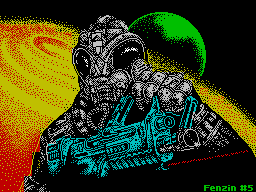
Cyberpunk
© “Fantakrim MEGA” #5/1991
Igor Tolokonnikov
The 1980s: Under the Sign of Cyberpunk
Few of those present at the banquet understood that a new term had just been born, but half the room turned at the cry: “Why, it’s cyberpunk!” “Well, of course, cyberpunk,” repeated Gardner Dozois, writer, editor, anthology compiler, and a major figure in literature—in both the literal and figurative senses. Now, ten years later, it is hard to say which story Dozois had in mind: William Gibson’s “Burning Chrome,” or something else. But the label stuck fast. “New science fiction of the new wave,” “New movement”—all of this was distilled into one precise, evocative word: “cyberpunk.”
Cyberpunk emerged as the literature of a generation raised on computers and Toffler’s philosophy.
The computer changed not only the way Americans lived, bringing credit cards, video games, and new means of communication into their daily lives. Most importantly, Toffler argued, the computer changed people by giving them another kind of power: knowledge about knowledge. Developments in genetics, alternative energy, oceanography, and environmental engineering are shaping a new environment and a new culture. As a result, the “electronic cottage”—an idea considered absurd at the dawn of the 1980s—became a reality. An “electronic cottage” means working from home; “home workers” are knowledge workers using home computers and video and telecommunications. (*) Our psyche was shaped by the biosphere, not by artificial environments and tools. The avalanche of information crashing down on our consciousness spills over into the inner hardening of the modern city dweller. Cyberpunk is an attempt to find an adequate literary reflection of the new world and the changed social consciousness, so that even the nervous pace of reading matches the nervousness of our existence.
Gibson, Rucker, Kadrey, and others made an impression above all because the future they had calculated turned out unlike the futures imagined by their predecessors. In traditional science fiction, the psychological landscapes of the human soul were always familiar and recognizable; the inner cosmos corresponded to the order of the material world. Gibson, however, focuses on the status quo of a boiling cauldron of information, where patterns made of fragments of information and human relationships emerge and disintegrate, and artificial-intelligence systems begin to develop spontaneously, perceiving humans, at best, as partners.
The birth of global cyberspace—the space of information—makes the question of further evolution irrelevant: for people, because the problem is solved by organ transplants and their replacement with highly efficient prostheses, and microprocessors implanted directly into the brain allow people to become part of cyberspace; for the information matrix itself, because computers make it possible to model the world in all the richness of its connections, with only the range of emotional sensations remaining as the sole link to the real world.
Mirrored sunglasses became the symbol of cyberpunk. (**)
Shining and alluring negation. Repellent independence. A screen and protection from the world. What lies behind the glasses? A person turned inward.
Cyber-society is recreated, as it were, from fragments of itself—from the unruly little tufts that stick up on a neatly mown lawn. It is therefore no surprise that the typical cyberpunk hero turns out, on closer inspection, to be an antihero: a free individual cannot exist in a corporate, hierarchical society, as in Shiner’s Frontier or Kadrey’s Metrophage.
The New Wave in its cyberpunk form proved extremely condensed: overloaded with impressions and compressed into dense clots of information, often repeated over and over. A text lavishly furnished with adjectives, adverbs, and passive linguistic constructions, among which the thread of the narrative dissolves, imitates a gestalt—the simultaneous existence of many entities.
This gives rise to the concept of a work’s logical depth. That means, for example, that if you dislike a book, it is not only because you have particular tastes, but also because the book belongs to a different class of complexity. That compressed, energetic, condensed style, rich in symbols drawn from the real world, is ideally suited to cyberpunk’s desire to saturate and intensify the logical depth of its prose, and to show the intrusion of future technology into contemporary life.
Some researchers find similarities between cyberpunk and the horror subgenre. But while horror reflects the drama of physical condition, cyberpunk attacks the very idea that this drama is real. Fragmenting familiar notions creates not fright or fear, but dread of the unreliability and ephemerality of existence. This fear is rooted in the very means by which memories of the surrounding world are preserved—in the transparent existence of electromagnetic impulses. This fear cannot end in catharsis; it does not purify, but condemns us to chronic fright at the prospect of being shut out of conceptual space and becoming not a physical cripple, but a cripple all the same.
The problems of a computerized future, the horror of an information monopoly, and cultural devolution, decked out—paradoxically—in vividly individual lifestyles: cyberpunk outlined this burden and tried to shoulder it. And...
Today, those who formed the core of the writers’ group have gone their separate ways, each developing their own “vein,” whatever it may be. The fist has unclenched; the fingers are spread wide.
Perhaps the rebels who imagined themselves pioneers have once again realized that no advances in superconducting technology or microminiaturization can change human nature—and that, in principle, the ancient Greeks already said everything there was to say about it?
() Toffler called the emerging new class the cognitariat (derived from cognitive*).
(*) In 1986, the cyberpunk anthology Mirrorshades* was published in the United States, with a manifesto-like preface by Bruce Sterling. There he paid tribute to writers who helped shape the cyberpunk worldview: Olaf Stapledon, with his philosophical prose, and H. G. Wells, with his social science fiction, as well as the literary mentors and creators of the 1960s New Wave: Harlan Ellison, Samuel R. Delany, Norman Spinrad, Michael Moorcock, Brian Aldiss, and James Ballard.
Share your thoughts about the article