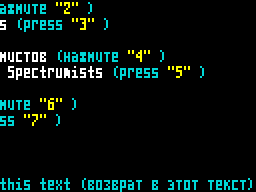
About chess
by Alone CoderAfter a period of fascination with Esperanto, my father became
interested in collecting computer logic games, especially chess
programs. I have already pubished the loading screen for the
game "iS-Chess 48", which he and I drew in 1993 when we made a
disk version of it. Besides iS-Chess (his favourite program
because of the interface), he liked Super Chess 3.5, which, in
his opinion, played better than all the others in the
collection. The collection consisted of the following programs:
iS-Chess 48 (Cyrus)
Cyrus 2
Spectrum Voice Chess
Psi Chess
Colossus 4 Chess
Masterchess
Chess Master 2000
Super Chess 3.1
Super Chess 3.5
It was not possible to fully master Psi Chess due to terrible
controls and lack of instructions. There was also Death Chess on
a cassette, but due to its frivolity we did not transfer it to
disk.
I later discovered the descendant of Super Chess 3.5, Clock
Chess (1989), which was officially advertised as the most
powerful chess program on the ZX Spectrum. But the descendant of
Cyrus 2 - ChessGenius - was released on the IBM PC, where in
1994 it was the first program to beat Garry Kasparov (it
received a FIDE rating of 2795 ). ChessGenius is currently
little known, but its version can be found for Android.
In total, there are 43 known chess programs on the ZX Spectrum,
according to Spectrum Computing. But none of them use extended
memory ( 128K and above) to improve the game.
The real level of chess programs that are unable to communicate
using standard chess protocols is difficult to determine.
In 2019, I manually played Clock Chess against Cyrus 2 and found
out the following:
- Cyrus 2 thinks faster.
- Clock Chess can be adjusted to play strength that is higher
than Cyrus 2.
LVD decompiled Cyrus 2, and it is now bundled with NedoOS,
including a version for Chess960. According to my estimates,
level "3" plays there at a strength of slightly above 1500
Lichess points (weak 3rd category, loses even against the
incorrect Elshad's opening), level "2" is above 1300, and level
"1" is about 1200. If the levels differ by about 100 points,
then the maximum level should correspond to a candidate master,
but I cannot verify this, because I do not play at such a
strength.
What we played at Cafe 2019 and DiHalt 2022 was a complete
inexperience. In the process of teaching my children chess for
a year and a half, I learned a lot of new things, but I play
with a maximum of 1800 Lichess points due to constant blunders.
It should be taken into account that on Lichess the scoring
starts at the level of 1500, not 1000 as in FIDE and ФШР, so the
rating is overestimated by about the same amount.
I enrolled my older children in the chess section at the local
sports school (for free), but there is no progress yet. To
evaluate the level of graduates of this section, I played a
couple of open 10+5 tournaments on a real board. It turned out
that I could not beat any children, only some adults. The final
ФШР rating was only 1105:
https://ratings.ruchess.ru/people/561391
Probably, I can raise it a little more, continuing to score 3
points out of 9, but I don't have time for that. Even as a
child, I was told that I could play at the 3rd category...
I created the group "ZX Spectrum" on Lichess
https://lichess.org/team/zx-spectrum and held several
tournaments, even streamed one. But people's interest is not yet
felt.
If someone wants to go through the initial stages of chess
training, I recommend solving problems on Lichess until you
reach level 1700 (or better 2000: there are more interesting
problems), and with white play the London system (you can learn
from the videos of Igor Nemtsev and Alex Banzea ), with black
the Sicilian Defense (Scheveningen). Unfortunately, I didn't
find any good video tutorials on Scheveningen; streamers don't
like it, so I learned it at random. I chose it because in other
openings you have to remember too many lines so as not to fall
into traps. You can also watch Shamil Arslanov and Alessia
Santeramo, they play rapid chess and comment their train of
thought in detail. It should be taken into account that Arslanov
plays mainly gambits, including the incorrect and mocking
Englund-Charlick gambit. These gambits most likely will not be
useful to you. However, the attacking style of play shown there
will come in handy. At a very beginner level, if you dont want
to learn any openings, you can try Chess960.
I started with time control 15+10, but quickly switched to 10+5.
I'm not quite comfortable with 5+3, especially in Chess960,
but it won't hurt you to practice this time so that
you have more attempts with the openings you use, and 10+5 on a
real board feels comparable to 5+3 on the screen.
To have an idea of typical endgame positions in which it is
advisable or undesirable to enter, it is worth reading Mark
Dvoretsky's book "Endgame Manual". According to reviews, masters
also periodically read it.
Share your thoughts about the article