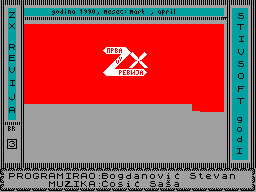
D) THE GOLDEN AGE OF THE RAINBOW
It all began not so long ago, in 1980, when former journalist and failed entrepreneur Clive Sinclair launched the first British home computer, the ZX-80. More precisely, it was launched by his company, Science of Cambridge, known for manufacturing inexpensive HI-FI systems. It cost less than 200 pounds, about 8,000 dinars at the time. It looked very much like a real RAINBOW.
It ran on the ZX-80 microprocessor, replacing a heap of chips with a ULA chip. The ROM-BASIC had been expanded to 8K, and it could calculate decimal numbers.
It had 1K of RAM, expandable up to 16K.
It displayed 22x32 characters on the screen and used the Inter Basic language.
This computer, together with a cassette recorder and a television, could be called the first home microcomputer system. And so began the golden age of the RAINBOW.
In 1981, the ZX-81 computer was released under the new name of Sinclair’s company, Sinclair Research.
It measured 17.5x16.5 cm, and its keyboard measured 16x6.5 cm.
It was black and had 40 keys (4x10). It used the principle of one key—one command, but ENTER was called NEW LINE. It also ran on the ZX-80 processor. It had only 1K of RAM and 16K of ROM, which was already an improvement.
The option to expand the RAM to 16K remained.
It could be connected to a cassette recorder. The screen remained the same (22x32), but it now ran Sinclair BASIC. It could also be connected to a printer.
At first, it cost less than 200 pounds, while near the end of its run, a model with 16K of RAM cost 80 DM. Finally, let us mention the characteristics of Sinclair’s computers: small dimensions, made of plastic and rubber, and, most importantly, low prices.
Because of their low price, Spectrums (at least the first versions) had no interfaces except the general-purpose one, and their keyboards were sticky, made of paper and plastic, with rubber keys.
For his first computers, Clive claimed that they could control a nuclear power plant. In principle, he was right, because access to all their processor functions was available through the general-purpose interface.
That’s all for now. Until the next issue!
č.S.
Share your thoughts about the article